

LOGISTICS STRATEGIES – JUNE 2026
Subject to complex operational constraints, combined transport is an ideal field for artificial intelligence. The tools developed as part of the ‘Appel d’aiR’ programme led by the AI Cargo Foundation demonstrate this, as does the Cumulus app. France Supply Chain, Club Déméter, FM Logistic, Combipass and Hexafret also bear witness to this.
Bringing shippers together to optimise or create rail services and opportunities for modal shift: this idea has given rise to two projects. The first, known as the ‘rail loop’ and led by the AI Cargo Foundation – with Club Déméter as a partner – pools the freight flows of ten manufacturers and three distributors to supply supermarkets. At this stage, “the identified potential for modal shift from road to rail amounts to 115,000 full lorry loads of groceries, pet food, frozen foods and drinks,” explains Julien Darthout, General Secretary of the Club Déméter.
 To be economically viable, the pre- and post-transport road journeys for these shipments must be less than 80 km, he explains. On this basis, seven terminals – linked together to form a national loop – have been identified in Paris–Île-de-France, Gevrey-Chambertin, Lyon, Miramas, Fenouillet, Hourcade and Saint-Pierre-des-Corps. Operating continuously six days a week with delivery times of 48 hours, the proposed service would cater for palletised consignments of three units or more. “Its launch is planned for this year,” says Julien Darthout.
A collaborative approach
To develop this model, road transport data from manufacturers and distributors was consolidated and processed by the Cumulus application. This application was developed by the AI Cargo Foundation as part of the CEE Appel d’aiR programme. “As a digital platform for modal shift that uses artificial intelligence, Cumulus enables users to search for and find up-to-date rail and inland waterway services, draw up a low-carbon transport plan and help create new combined transport services,” explains Guillaume Desveaux, president of the AI Cargo Foundation. Postcode, delivery date, and criteria such as distance and/or duration for pre- and post-carriage are just some of the details required to obtain services ranked by greenhouse gas (GHG) emissions savings. For more complex analyses, it is possible to import files on transport flows.
All data used is anonymised to protect the confidentiality of shippers who pool their freight flows. Led by France Supply Chain’s Supply-Chain4Good Lab, a second rail freight pooling scheme modelled using the Cumulus tool is currently under consideration. “It brings together the national and European freight flows of the Michelin, Saint-Gobain, Legrand, PepsiCo and Renault groups,” explained Florence Ughetto, a sustainable development and logistics expert at Renault, during a debrief on the Appel d’aiR programme. Their work identified 11 shared corridors. Of these, three were selected for consultation with rail operators, with the assistance of the consultancy firm Argon.
One of the challenges encountered in studying this project is synchronising manufacturers’ freight flows whilst optimising transport costs and stock levels, notes Florence Ughetto.
Logistics offering
The operation of several million square metres of warehouse space also offers opportunities for consolidation and pooling to encourage a modal shift. This is illustrated by the collaborative initiative launched by FM Logistic, bringing together “rail transport operators, shippers, logistics providers, freight forwarders and road hauliers”, as outlined by its Head of European Multimodal Development, Sylvain Philippe.
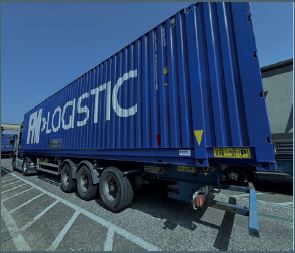 To identify freight flows that could be shifted from road to rail, the logistics provider shared its data with Hexafret (formerly Fret SNCF) before using the Cumulus application. In France, analyses revealed a transfer potential of nearly 4.6 million pallets, representing around 140,000 full road journeys. “The anonymisation of the data made it easier to get customers on board with the study,” confirms Sylvain Philippe. This survey led to the launch of the first daily door-to-door combined transport service, introduced by FM Logistic in September 2024. Between Avignon and Valenton, it avoids more than 2,000 road journeys per year. This north-south corridor, which can be extended as far as Lille and Arles, is one of the services included in the Cumulus platform. In mid-January, it was expanded to include an international link between Dourges and Poland (Krzewie and Kutno). These multimodal initiatives “form part of our Powering 2030 strategy, which aims to reduce our GHG emissions and support our customers in decarbonising their supply chains”, emphasises Sylvain Philippe.
Growth potential
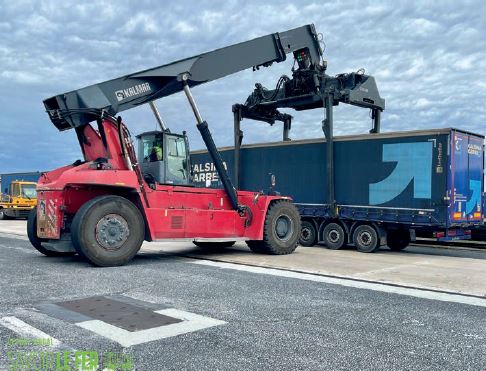
On its domestic north-south corridor, FM Logistic is deploying a fleet of around a dozen 45-foot swap bodies, each capable of carrying 33 pallets, just like a road semi-trailer. They were designed by Combipass. This subsidiary of the Berto Group specialises in the design and hire of bespoke intermodal transport units (ITUs), which are eligible for funding under the energy-saving certificates scheme.
When carrying out studies on combined transport services – another of its areas of expertise – Combipass uses the Cumulus tool to process transport data and identify existing or proposed services. According to its director, Gilles Delvigne, the cost difference between combined rail-road transport and road transport is said to be “no more than 3 per cent, whilst delivering an 81 per cent reduction in CO₂ emissions”.
Hexafret has also adopted Cumulus’s AI features in the modal shift studies it carries out for its clients. Convinced of rail’s potential, its director of development, Gilles Cattani, points out that over 80 per cent of trains and wagons return empty on known, scheduled train paths, and that there are reportedly more than 2,000 connected sites and freight routes in operation.
By Erick Demangeon
Article Logistics Strategies