

LE NOUVEL ECONOMISTE – SEPTEMBER 2025
Rail-road transport offers significant advantages in terms of reducing emissions, provided that the rail network is modernised.
Faced with the challenge of decarbonising freight transport, multimodal transport, which combines rail and road, has serious advantages. In addition to a clear advantage in terms of emissions compared to road transport alone, it offers flexibility that is well suited to the needs of businesses, enabling it to double its traffic in ten years. However, there are still obstacles in terms of cost and ageing infrastructure. The government plans to invest, while industry representatives are looking to public-private partnerships. Artificial intelligence and the pooling of flows also offer new opportunities
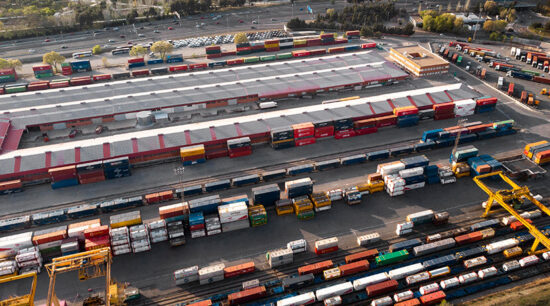
When it comes to rail freight, all hopes are now pinned on combined transport. This multimodal model, which involves transferring containers, swap bodies or entire semi-trailers from lorries to trains, is gaining momentum. Its traffic doubled between 2012 and 2022 and now accounts for 40% of French rail freight, which is in overall decline. The ‘old-fashioned’ system, which involves transporting bulk raw materials in full trains, is suffering from deindustrialisation, which is making it increasingly difficult to find shippers large enough to fill entire trains. Combined transport owes its success precisely to its ability to consolidate goods from several customers, thereby optimising train capacity, a key factor in the competitiveness of rail compared to road transport.
The Ulysse Fret programme plans to invest €4 billion in freight, including €1 billion by 2032 for terminals.
Given the imperatives of decarbonisation, making rail more attractive is a huge challenge. Compared to road transport, rail freight enables a massive reduction in emissions. ‘Taking into account pre- and post-road transport and the type of rail traction (diesel or electric), the gain is between 60% and 70%,’ says Bernard Guilbot, director of the Appel d’aiR modal shift programme at AI Cargo Foundation. Trains also consume six times less energy than lorries and offer other advantages, such as reduced noise pollution, road congestion and accidents. However, road transport still dominates, accounting for 88% of freight flows. France, lagging behind its European neighbours, has set itself an ambitious target: to double the share of rail freight from 9% to 18% by 2030.
One billion euros to modernise terminals
To support the development of freight transport, the government has introduced a range of incentives, including subsidies for combined transport services and contributions towards toll charges. The Ulysse Fret programme also plans to invest €4 billion in freight, including €1 billion between now and 2032 to modernise and expand existing terminals and build new ones where there is real market demand. ‘This is essential for our development over the next fifteen years,’ says Aurélien Barbé, General Delegate of the National Combined Transport Group (GNTC). We have carried out a forward-looking study with the Ministry of Transport on a master plan for multimodal platforms. We analysed the current network of platforms, demand from shippers, customers and road hauliers, costs, etc. The need is mainly concentrated in three major regions: Ile-de-France, Auvergne-Rhône-Alpes and the North.”
Aging and saturated, the network of multimodal platforms and combined transport terminals is insufficient to meet France’s ambitious goals. ‘The gantry cranes that carry containers, for example, are sometimes forty years old,’ says Sylvain Philippe, head of European multimodal development at FM Logistic.
Faced with dwindling public funds, the sector is seeking new partners. ‘We are in contact with banks and investment funds. We would like to develop public-private partnerships or entirely private models to complement the current offering,’ says Aurélien Barbé. ‘In addition to operating ships, shipping companies want to provide pre- and post-transport by truck, but also by rail and river.’ In fact, CMA CGM recently announced a €40 million investment to modernise the two terminals for handling containers and heavy packages at the port of Lyon. For its part, MSC, through its subsidiary Medlog, has invested in a multimodal terminal (Medlog Inland Terminal Paris-Bruyères) to provide connections to rail and barges.
Less reliable than road transport
However, inadequate and outdated infrastructure are not the only obstacles to the development of large-scale combined transport. Cost, speed and quality of service still leave much to be desired. With an availability and reliability rate of 65%, compared to 95% for road transport, rail suffers from delays and cancellations. The priority often given to passenger transport and night-time works make it difficult to obtain train paths that meet market demand. ‘This is why an industrialist who is familiar with the vagaries of the network will only put part of his flows on the railways, to guarantee a road service if necessary,’ says Bernard Guilbot. Due to breakdowns and other unforeseen events, trains are generally slower and more expensive than road transport for distances of less than 500 km. Beyond that, the uncertainties are offset and rail becomes more competitive, as trains do not stop when lorry drivers finish their day. A train takes twelve hours to travel from Paris to Milan, whereas it takes a day and a half by lorry.
“It is on pan-European flows, particularly between Poland and Spain, that the greatest potential lies.”
But empty return trips drive up costs, even over the shortest distances. “At one time, we used combined rail and road transport for various customers on the Dourges-Marseille route [from Pas-de-Calais, editor’s note], Avignon, Lyon and Bordeaux. We were delivering crisps for holidaymakers’ aperitifs, but we didn’t have enough freight to bring back,” says a French carrier. Balancing flows on both the outward and return journeys is therefore essential to the combined transport business model.
The promise of AI
From this point of view, artificial intelligence (AI) could provide solutions for detecting shipper flows. Large groups are already relying on data analysis to create ‘transport loops’ (see box) and develop shared modal shift solutions.
In addition, the Appel d’aiR programme, created in response to a call for projects from the Directorate-General for Energy and Climate, uses AI to help local authorities identify opportunities for pooling resources and new rail or river services to decarbonise their region. Its digital platform, which lists 3,800 rail and river freight services in Europe, also carries out simulations to assess the economic and environmental relevance of a combined transport route.
With a European carbon tax looming on the horizon for 2027 as part of the emissions trading system, combined transport could become more attractive, particularly over long distances. ‘It is on pan-European routes, particularly between Poland and Spain, that the greatest potential lies,’ says Bernard Guilbot. While biofuels suffer from a lack of availability and relatively high prices, alternatives for decarbonised fleets (electric trucks, hydrogen trucks) are not yet ready. However, their TCO (Total Cost of Ownership) should improve over time and offer shippers a combination of complementary, decarbonised solutions.